

Recently, another batch of sodium-ion microgrid projects of Zonergy have been successively completed and commissioned in Muli County and Yanyuan County, Liangshan Yi Autonomous Prefecture, Sichuan Province, and have been operating stably for more than three months. Meanwhile, more projects are in the planning and construction phases.
Following its deployments in Xizang and Xinjiang, this represents another batch application of Zonergy’s independently developed “Arctic” series sodium-ion cells tailored for cold, high-altitude environments in microgrid projects. Its significance lies not merely in the rollout of sodium-ion technology, but also in responding to practical needs. Through deep integration of technology and application scenarios, it delivers more stable and reliable power supply guarantee for remote areas. Long-term operational data in turn feeds back into R&D, forming a virtuous cycle in which technological innovation and on-site applications boost each other.
Adapting to local conditions: Another batch of sodium-ion microgrids deployed in Liangshan, Sichuan
The Liangshan area of Sichuan features complex terrain, making grid extension difficult for some remote villages. Subject to factors including altitude, temperature and geographic conditions, off-grid microgrids here must meet stringent requirements for power supply stability, environmental adaptability and long-term operational performance.
Drawing on more than a decade of experience in standalone photovoltaic power supply projects, the Zonergy team carried out thorough on-site investigations. It comprehensively evaluated the geographic and climatic features, electrical loads and power demand of individual sites to develop site-specific “PV + sodium-ion energy storage” solutions. These schemes fully capitalize on the strengths of sodium-ion batteries, such as wide operating temperature range, long service life and high safety, to provide stable and reliable power supply for remote villages and public institutions.
To date, Zonergy has completed two sodium-ion microgrid projects in Bowo Township of Muli County and Wali Township of Yanyuan County. They are equipped with sodium-ion energy storage systems of 1,070 kWh and 856 kWh respectively, both adopting the company’s independently developed Model 72174, 170Ah “Arctic” series sodium-ion cells.
Both sites are running with satisfactory performance and have supplied continuous and stable power for over three months. This has preliminarily verified the operational adaptability of sodium-ion energy storage systems under local actual working conditions and gathered valuable on-site data for subsequent project construction. At the same time, more sodium-ion projects are moving forward steadily, with planning and construction to be carried out in an orderly manner.
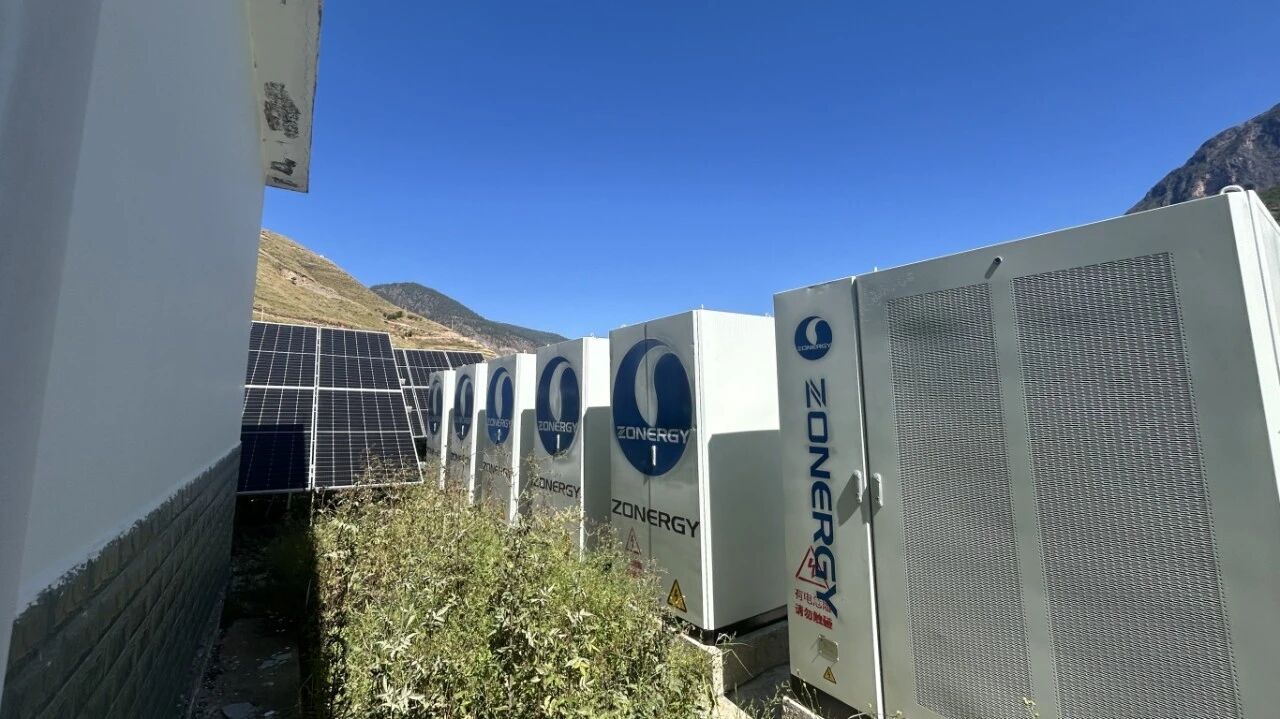
Zonergy’s sodium-ion power sites in Wali Township and Bowo Township
Innovative iteration: Adapting continuously to complex environments from cell to system level
Unlike the cold high-altitude environment of Xizang and the arid environment with large temperature swings in Xinjiang, Liangshan in Sichuan boasts diverse landforms such as mountains and canyons with prominent vertical climatic differences. This brings new challenges to the scheme design and on-site implementation of sodium-ion PV-storage systems and sets a key direction for technical optimization.
At the cell level, the Zonergy team focused on improving the low-temperature discharge capability of cells. The product achieves a capacity retention of more than 90% at -40°C. The team also optimized the operating temperature range to strengthen the system’s capacity to handle seasonal low temperatures and diurnal temperature variations. In addition, R&D staff further optimized the pressure adaptability and deformation resistance of cell casings to eliminate potential risks of “high-altitude swelling”. This ensures that even at unattended remote sites, operation can be ‘worry-free’ and reduces the demand and frequency of operation and maintenance.
At the energy storage system level, compared with the earlier integrated PV-storage all-in-one unit solution, projects in the Liangshan region have further refined system design by adopting a modular PCS + DC-DC energy storage control architecture. This improves the flexibility and cost-effectiveness of system configuration while satisfying project operational requirements.
At the software level, the projects deploy Zonergy’s independently developed energy management system (EMS). It enhances capabilities for system status monitoring, charge/discharge strategy management and fault response, and also facilitates subsequent intelligent monitoring and remote troubleshooting.
People–centered development: Enabling sodium–ion technology to take root and benefit local communities
From Xizang to Xinjiang and then to Sichuan, Zonergy’s sodium-ion microgrid development has never been a simple replication of one technical solution or a mere pile of project numbers. Instead, it continuously advances collaborative innovation in cell technology, energy storage systems and energy management in light of the environmental features and practical needs of different regions.
Yang Yanhu, Regional Head of the Engineering Department at Zonergy, explained that following the construction of the pilot sodium-ion microgrid project in Xizang in 2025, which received positive feedback from multiple stakeholders, the team gained first-hand insight into the application value of sodium-ion technology in cold, high-altitude zones. “On the one hand, we report to the company and competent authorities and demonstrate the feasibility of large-scale sodium-ion microgrid deployment; on the other hand, we organize project teams to carry out on-site inspections and assessments of nearly 200 stations across the three prefectures. We scientifically select areas suitable for sodium-ion applications where the technical strengths of sodium-ion batteries can be fully unlocked, and push project construction forward in a steady manner.”
Currently, Yang Yanhu and his team are stationed on the frontlines of project construction to deliver more sodium-ion microgrid projects and help them take root locally.
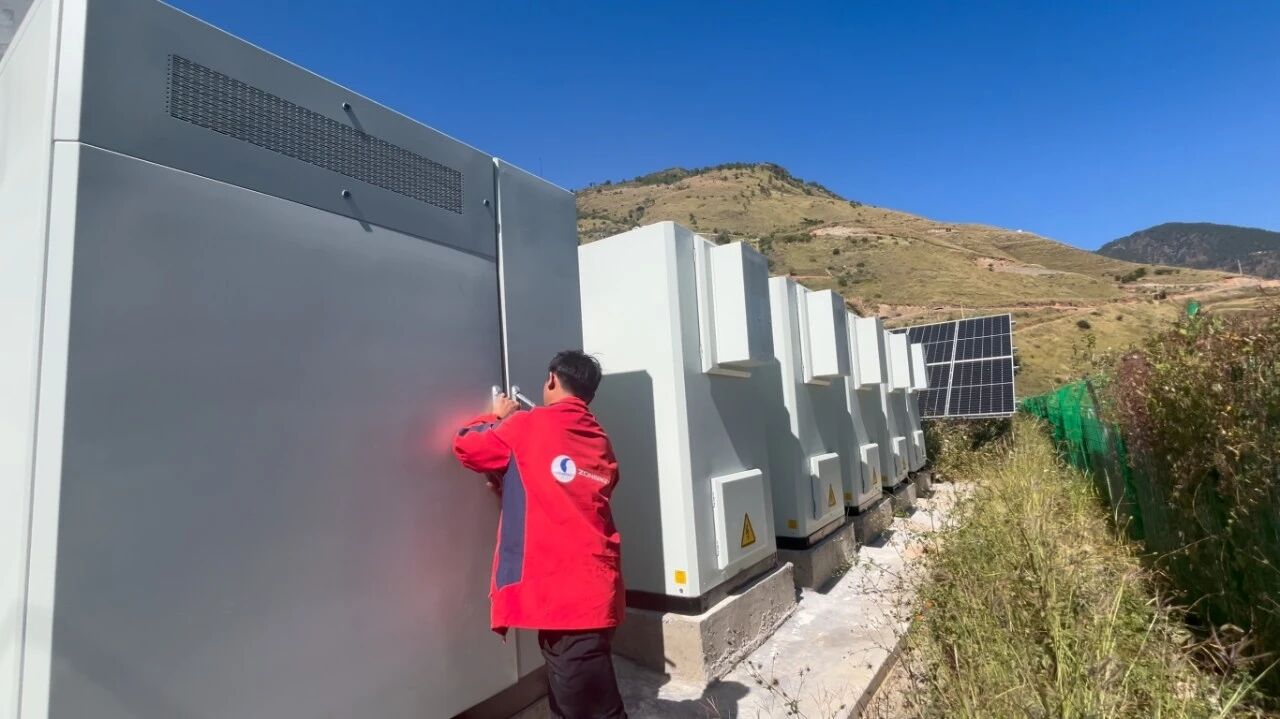
Routine inspection of sodium–ion stations by Zonergy O&M personnel
From plateaus to canyons: Validating technology in real–world settings to push the boundaries of sodium–ion applications
The 170Ah sodium-ion cells adopted in the Liangshan projects belong to the same “Arctic” series independently developed by Zonergy as those deployed in earlier microgrid projects in Shigatse, Xizang, and Kashgar, Xinjiang. This series covers multiple models including 160Ah and 170Ah, with large-scale deliveries exceeding 10 MWh.
As winter sets in, the commissioned projects in Liangshan will undergo further validation under seasonal low temperatures and complex operating conditions. Zonergy will keep tracking project operational performance, collect real-world operating data across diverse environments, dynamically optimize system operation strategies, and translate field experience into the planning, construction and O&M of future projects.
“Real-world scenarios serve as critical test beds for technological innovation, and continuously accumulated operational data form an essential foundation for advancing R&D of next-generation products.” Su Heng, Dean of the Zonergy Sodium Battery Research Institute, stated that by continuously analyzing operational data from projects in different regions and under varied working conditions, the R&D team can gain deeper understanding of the actual performance and optimization paths of sodium-ion cells. This underpins technological innovation in material systems, cell structures, temperature adaptability and cycle life. Meanwhile, drawing on system operational efficiency, charge/discharge strategies and O&M feedback, the company’s PV-storage product R&D team can further drive the continuous optimization of energy storage system architectures, energy management strategies and overall solutions.
From R&D to project deployment, and from field operation to feedback-led optimization, Zonergy is gradually building a closed loop for technological iteration that is rooted in real-world scenarios and backed by operational data. This allows sodium-ion technology to reach maturity through repeated validation and extend its application boundaries through continuous innovation.
From the southwestern Qinghai-Xizang Plateau to the eastern foothills of the Pamir Plateau and onward to Daliangshan in Sichuan, the application footprint of Zonergy’s sodium-ion technology keeps expanding. Across plateaus and canyons, having withstood tests in diverse environments, Zonergy’s sodium-ion technology is advancing steadily toward broader opportunities.